Celebrating ....

CELEBRATING The PJ's 50th YEAR! * www.junto.blogspot.com * Dr Franklin's Diary * Home of the Philly Cheapskate*Contact @ WritersClearinghouse@yahoo.com * Join WritersClearinghouse at Facebook, Instagram, etc. *Meeting @ Philadelphia * Empowered by WritersClearinghouse.
Showing posts with label Chagall Marc. Show all posts

Wednesday, 1 September 2010

In a Divided City...


... A Divided Marc Chagall
By Richard Carreño
[Writers Clearinghouse News Service]

Jerusalem.
After touring Israel's chief museums and art repositories, it'd be easy to think that Marc Chagall (1887-1985) is this country's 'national' artist. Dozens of the artist's masterful oils, from early to later pieces, are prominently displayed at the Tel Aviv Museum of Art and, here in Jerusalem, at the recently reopened Israel Museum, an encylopedic institution that stands among the world's great museums. (This in a country that's about the size of New Jersey).

Even in small ways, it's not hard to be reminded to Chagall's presence here. Over a drink at the American Colony Hotel recently, I looked up to see a plaque listing many of the prominent personages who have stayed at the hotel. Hardby Peter Ustinov's name was that of Chagall's.

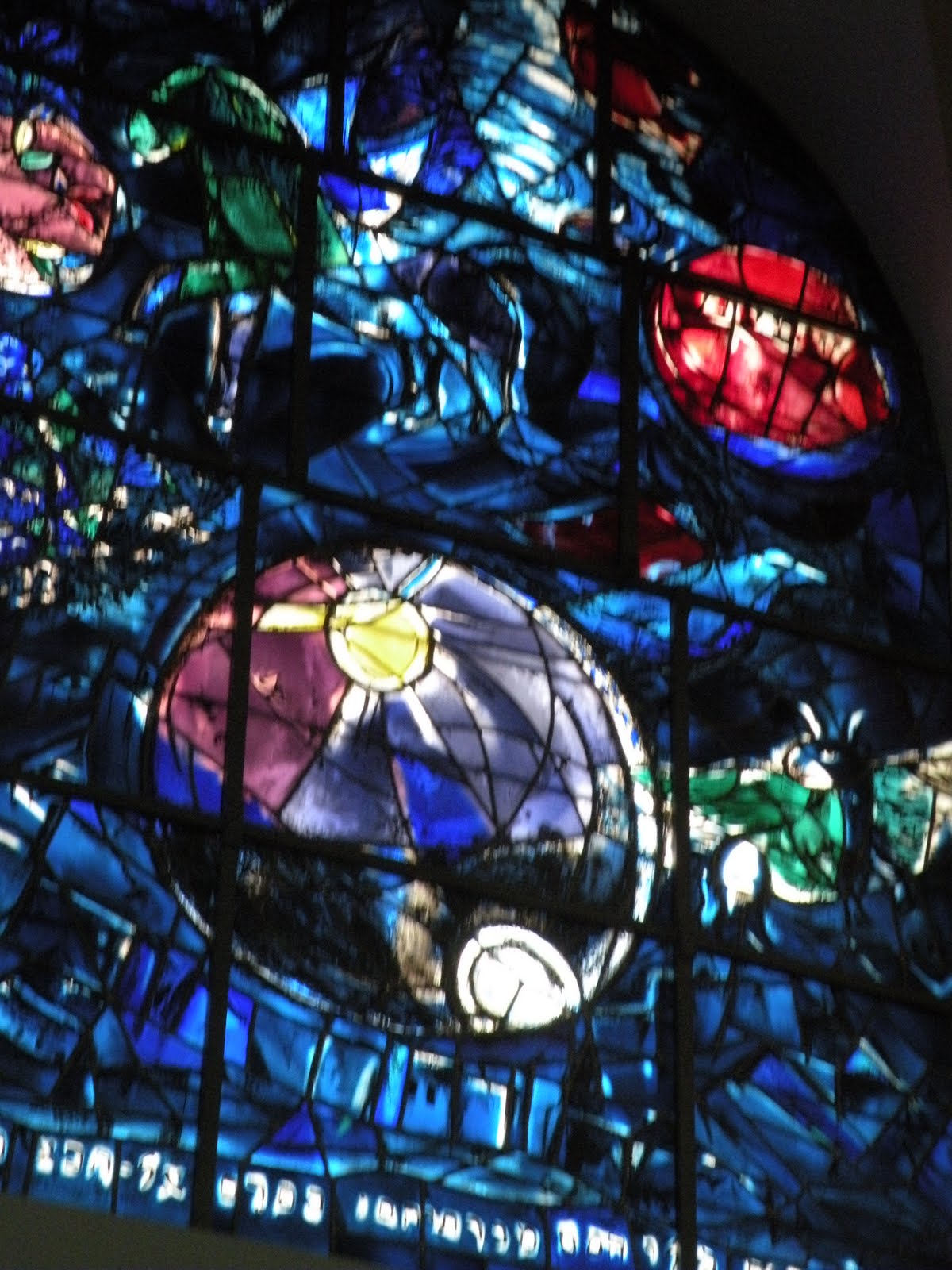
Nowhere is Chagall's presence felt as dominantly -- and soulfully -- as in the Synagogue of the Hadassah-Hebrew University Medical Center, atop Mt. Scopus along Jerusalem's western edge. And nowhere is the counterpoint of the art, culture, and history of this capital, divided by Muslim and Jew, so markedly pointed as in this house of worship, home to the Chagall Windows, what well may be the multi-facited artist's best work in stained glass.

The 12 windows, installed in 1962, dipict the Twelve Lost Tribes of Israel, frame the synagogue's four walls, and are illuminated by natural light streaming from above.

Fortunately, the windows are again on display. For more than a year the Haddassah synagogue was closed, just reopening this month. (Underground, bomb-proofed operating theatres were being constructed nearby, requiring that the windows be encased to protect them from shattering).

As art, infused with Chagall's well-known 'dancing' figures and bold colours, the windows are breathtaking.

For Jews, in particular, in this place, in this time, the windows also evoke the thousands-of-years struggle for their recognition in this Holy Land. Art, yes. But also a defining sense of majestic being as the Sons of Jacob.

Tinting windows was not a new medium for Chagall. But the Chagall Windows, celebrating the Jewish peoples of this new homeland, significantly differ from much of the artist's most dominant thematic memes, often the Ashkenazi shetel life of Russia and Eastern Europe.

This social-realist, even secular artist, as opposed to the Biblical artist of the Hadassah synagogue, is one best known in Europe and in North America. (And not unknown, of course, in Israel itself. The Israel Museum mounted a retrospective in the 80s).

Not surprisingly, the European Chagall will also be on offer when the Philadelphia Museum of Art presents next year its own version of the non-Biblical artist in an exhibition of mostly secular works. (Titled 'Paris Through the Window: Marc Chagall and His Circle,' the show will run from March to July in the Perelman Building).

Despite Israeli admiration, both personal and professional, Chagall never really returned the favour. He didn't identify himself as a Zionist, nor did he seek Israeli citizenship (his, as a Jew, for the asking), nor did he contemplate making aliyah, an official, ritualistic form of repatriation by a Jew in diaspora.

Almost since the founding of this Jewish homeland in 1948, Israel has tried to claim Chagall as one of their own. The artist was named an honorary citizen of Jerusalem, and, in 1950's, the late prime minister, Golda Meir, offered the artist a subsidy if he would spend in winters working in the northern Mediterrean port city of Haifa. He declined. Instead, he took a winter home in St.-Paul-de-Vence, in the south of France.

In fact, Chagall felt so fiercely about the creative forces eminating from his own adopted homeland of France (he was a naturalised citizen), he declared that only in France could he manifest his artistry. (The windows were created in France, shipped to Jerusalem).

Even in dedicating the windows, Chagall sounded less the Zionist than simply a committed Jew.

'My modest gift to the Jewish people, who have always dreamt of Biblical love, of friendship, and peace among all people; to that people which lived here, thousands of years ago, among other Semitic peoples,' he said. 'My hope is that I hereby extend my hand to seekers of culture, to poets, and to artists among the neighbouring peoples.'

Chagall died at 97 in St.-Paul-de-Vence, and was laid to rest in a local Christian cemetery.

Thursday, 22 July 2010

Philadelphia Museum in Context

Context Cues: Philadelphia Museum's Michael Taylor Busts the Blockbuster
By Richard Carreño
Junto Senior Staff Writer Bio
'I'm all about context,' says Michael Taylor, modern art curator at the Philadelphia Museum of Art.

Part scholar, part art historian, and part sleuth -- he's run down paintings throughout the world with the skill and patience of cold-case investigator -- the cherub-looking Taylor is also all about the serious study of art. By the public. By the masses.

'You don't bring in the masses by dumbing down,' he told me recently. 'The public will come to see great art,' he added, stressing 'great.' 'Unfortunately, marketing has taken over the art.'

Step forward a new breed of the curatorial anti-hero, of which Taylor represents its vanguard. Pedagogical. Pensive. And patient.

A properly mounted show, from initial conception, to research, funding, to hanging the pictures and selling the popcorn, takes about five years, according to Taylor. Minimum, four years, if you cut corners, he says.

'I've felt like I've spent my entire career in undoing what that man did,' Taylor quipped.

That man was the late Thomas Hoving, the show-boating director of the Metropolitan Museum of Art from 1967 to 1977, and, most significant, the putative creator of what has become known as the art exhibit 'blockbuster.' (One of Hoving's first blockbusters was 'Kings and Things,' for which he commanded the Met's 18 curatorial departments to conceive and deliver within 30 days!)

If Hoving was the 'hero' of that mega-show movement, you can easily see why Taylor is its anti-hero -- balding, professorial, and erudite. And jolly. Taylor smiles a lot. And chuckles. He's also having a good time.

Not that Taylor, in his 13 years since arriving at the PMA from his native England (he holds a doctorate from the Courtauld Institute in London), hasn't his share of 'rilly big shews.'

Under his belt in recent years have been well-received exhibitions dedicated to Duchamp, Matisse, Cezane, Dali, Gorky, and, earlier this year, Picasso. None was simply a broad-brush retrospective, but rather 'slices' in the artists' lives that emphasized a contextual and supportive narrative. If an individual artist, say, Duchamps, highlighted that context, as was the need in the 'Picasso and the Avant-Garde in Paris,' then Talyor offered viewers that perspective. (Nude Descending a Staircase in this case).

Taylor was also a major contributor to the Art Museum's Bruce Nauman show at the Venice Biennale in 2009, in which the PMA picked up a covetted Golden Lion.

Further underscoring Taylor's virtuosity is his relative youth. (Only 42). And vigour. He still finds time to teach art history at the Univrersity of Pennsylvania.

Interestingly, Taylor's ruminative approach also runs counter to the flamboyant style of his former mentor, the late Anne d'Harnoncourt, the PMA director who recruited him in 1997 after seeing some of his work at Centre Georges Pompidou in Paris. (He was appointed the PMA's curator of modern art, on a fast track, seven years later).

D'Harnoncourt, who died in 2008, was, like Hoving, a larger-than-life figure and equally well known as a pioneer in staging blockbusters. (As the PMA director's torch has now passed to Timothy Rub, 58 years old, one can't help but think that Taylor also represents a similar generational change).

I met with Taylor not long ago at the main branch of the Free Library, where, he was, of all things, minutely detailing (slides included) his next show, another laser-beam focused exhibit on Marc Chagall (1887-1985). (The show will be titled 'Paris Through the Window: Marc Chagall and His Circle,' and will be installed in the Perelman Building from March to July, 2011).

Taylor was explaining how a major show, as the Chagall head-line act, gets put together. A least, in his adulthood. (He was 17 when Chagall died in 1985, the same year the PMA held its last Chagall exhibit, a retrospective).

It started as a discussion in 2006, and resulted in trips to Paris, Berlin, London, and New York. In all, about 50 works will be displayed, including works by Soutine, Modigiliani, and De Chico drawn from the Art Museum's permanent collection. Taylor said he followed 'context.' 'Again, we were taken on a journey,' he told a smallish audience. 'I didn't know where I would be taken.'

Starting with in-house work, Self-Portrait (1914), he moved to the Tate Modern, in London, for The Poet Reclining(1915), and later to New York, at the Guggenheim, where Paris Through the Window, a 1913 oil on canvas that Talyor branded as the artist's 'masterpiece,' was nailed down as the Philadelphia's show's eponymous signature work.

That last find wasn't easily acquired in that Guggenheim curators, according to Taylor, are 'something like horse traders.' The Guggenheim, he said, is 'notorious' for demanding reciprocal loans to their shows. 'I don't subscribe to this personally. I like to help other curators out,' he said.

Still, Taylor went on, the Guggenheim method is better than that of some French curators, who boldly request payment. ('We never pay for loans,' he said. 'We always say "no" to that. It always sets a bad precedent. Despite how great a work is, I'll walk away.')

On the other hand, private collectors -- one picture in the Chagall show falls into ths category -- are usually 'thrilled' to be counted in a major show. In the eyes of the owner, a loan request from the PMA 'validates' the work's value (and the owner's taste), and 'they also get attention at gala parties.'

One thing that Taylor doesn't have any control over is ticket pricing. 'I often think we charge too much,' he said.