RICHARD CARREÑO AN INVENTIVE LIFE Philabooks|Press
 |
|
Reviewed by Mark Steadman
The Inventive Life of George H. McFadden: Archaeologist, Poet, Scholar, Spy
by Richard Carreño
Camino Books, Inc.
September 2024, Hardcover, 280 pages, ISBN-13: 978-1680980608
The new book by Richard Carreño, a biography of George H. Mcfadden, charts his journey from Princeton to Cyprus and his untimely death at sea. Born into wealth in Philadelphia, and after graduating from Princeton his obsession with archeology leads him to set sail for Cyprus where he went to dig at the acropolis of Kourion under the aegis of his alma mater. Living in what is now the Kourion Archeological Museum George wrote, translated and studied history. His idiosyncrasy can be summed up in his mantra: “Where the purpose of a rule in any instance does not seem to apply. I have ignored the rule.”
A touch platitudinous, but for some reason a phrase that Carreño feels bears repeating from time to time throughout the book, but so begins the story of George H McFadden III.
The writing Is marvellously indulgent. He has a penchant for French terms like “chacun a son gout” and “bonhomie” as well as pleasingly old-fashioned phrases such as “kith and kin”, “betwixt and between” and “home and hearth”. He also has the fun tendency of juxtaposing slang with Latin or antiquated phrases as in the following: “Wartime bed-hopping in Alexandria was time-honoured – but only spoken of in sotto voce tones.”
Or: “Rainey attempted bonhomie and collegiality. But his efforts mostly filled, often just shorts of puffery.”
The story bounces along, as McFadden does, through Europe on his archeological quests, with the odd Italian, French or Latin phrase thrown in here and there. He writes with a sense of humour as well. Comedy is about surprises, so said the late, great Norm Macdonald and Carreño has a good feel for misdirection as in these Bill Bryson-esque passages:
“While Fales, Cox, Last, and others, onsite at Kourion, tackled their tasks, oblivious to Raineys and Madeira’s plans for empire-building elsewhere, McFadden took time to slack off.”
“The director knew that McFadden lacked the swag of academic rank.”
FEAR AND LOATHING:
AN AMERICAN ARCHAEOLOGIST'S MYSTERIOUS LOCAL DEATH
In a new book about American archaeologist George H. McFadden, author Richard Carreño explores McFadden’s the life in Episkopi, Cyprus as a famed digger at Kourion and, later, his still largely unexplained death at sea in 1953. Carreño, a writer from the United States, explores McFadden’s many faceted life as an accomplished archaeologist, a World War II American spy in Cyprus, a poet, and scholar and the intrigue that led to his possibly nefarious death in The Inventive Life of George H. McFadden: Archaeologist, Poet, Scholar, Spy, soon to be published by Camino Books, Philadelphia, USA. The book will be available in major local bookshops, where English-language books are available.
An excerpt, adapted from the book, follows:
GEORGE H. McFADDEN was the scion of one of the twentieth century’s richest and most prominent Philadelphia families. His abbreviated life, cut short by drowning when he was nearly forty-six years old, was crammed with adventure, scholarship, and service to country. He was a reluctant cotton broker; an accomplished poet; a scholar of ancient Greece and Rome; a student of German literature; a translator of ancient Greek texts; an operative for the US wartime spy service, the Office of Strategic Services (OSS); and for many years an archaeologist with the University of Pennsylvania Museum of Archaeology and Anthropology in Philadelphia. He was a devotée of Greek national life—an unabashed philhellene—and a founder and financier of Penn’s extensive archaeological project at Kourion in southwest Cyprus.
Despite a life salted with daring, enterprise, and intrigue—the stuff of high drama—McFadden bore a weight of inescapable melancholy. He was estranged from his parents. His siblings were remote. He never married. Personal relationships were founded more by association than friendship. They were often marred by conflict; seldom, to his chagrin, by mutual respect. He was close to only a few. He closeted his homosexuality, knowing its disclosure would have resulted in professional and social ruin.
McFadden died in 1953, in a sailing mishap off the southern coast of Cyprus, not far from Penn’s pioneering—and McFadden’s beloved—excavation of Kourion, a celebrated site in Greek and Roman history. How he met his end has never been fully resolved; his death being the subject of lingering controversy. Though few remember the circumstances of his ambiguous demise, details remain decades later shrouded in suspicion and mystery. Some to this day believe McFadden was murdered by a British spy. Despite McFadden’s infectious brio and often capricious derring-do, Cyprus by the time of his death had soured for him, becoming “an island of bitter lemons.”
GEORGE McFADDEN WAS not a professional archaeologist, the kind of classically trained academic usually deployed to faraway lands by learned institutions. He found his scholarly strength in English literature, always earning high marks at Princeton University and the University of Pennsylvania. His career as a digger—and master amateur of archaeology—came later.
McFadden’s life was circumscribed by geographical boundaries he imposed upon himself. Cyprus, while not his native land, became his homeland. He was cocooned in a drama shrunk to a cast of few players. Intersecting his world at work and at war were less than a dozen principals. His life drama contained moments of farce, with real-life players never far from departing from one slamming door, entering another, or figuring in bit scenes as “noises off.”
McFadden's inner world was conflicted. His homosexuality was an open secret, possibility contributing to bouts of moodiness and depression. McFadden found himself in the depths of that fissure.
 |
| Harry's New York Bar |
 |
| Sir Winston Churchill Pub |


.jpg)
The Inventive Life of George H. McFadden
Richard Carreño
Camino Books, Inc.
9781680980608 $35.00 Hardcover
https://www.caminobooks.com/
Richard Carreño’s biography of Philadelphia art collector John H.
McFadden, John McFadden and his Age, provided a wealth of information
applicable to art history in general and Philadelphia history in particular.
McFadden himself provides the introduction to Carreño’s latest foray into
biographical history, The Inventive Life of George H. McFadden. This book
serves as a fitting companion volume, examining John’s Uncle George’s life
of intrigue, mystery, adventure, and Philadelphia connections.
This is not to say that either book should be limited to Pennsylvania readers
and collections—not by a long shot. Indeed, especially in The Inventive Life
of George H. McFadden, the value lies in Carreño’s ability to present contrasts
in intellectual drive, psychological melancholy and isolation, closet homosexuality,
and life contributions in such a manner that invites attention and inspection
by audiences immersed in life stories and intellectual pursuits alike … not just
Pennsylvanians or art students.
George H. McFadden stood out from the proper Philadelphian in many ways.
His different relationships and personas in disparate cultural groups, his shifting
approach to “finding ancient things” that led him to sailing and travel experiences
(and, ultimately, to a mysterious death), and his literary prowess all come to
light in a revealing examination of a Renaissance Man whose intellectual pursuits
were anything but ordinary.

.jpg)
 |
| The way they were. (Top and below) |

 |
| Functioning? |
 |
| The way they are. |

 |
| The "old" John Bull, Ltd., then across from Rawson Square. |

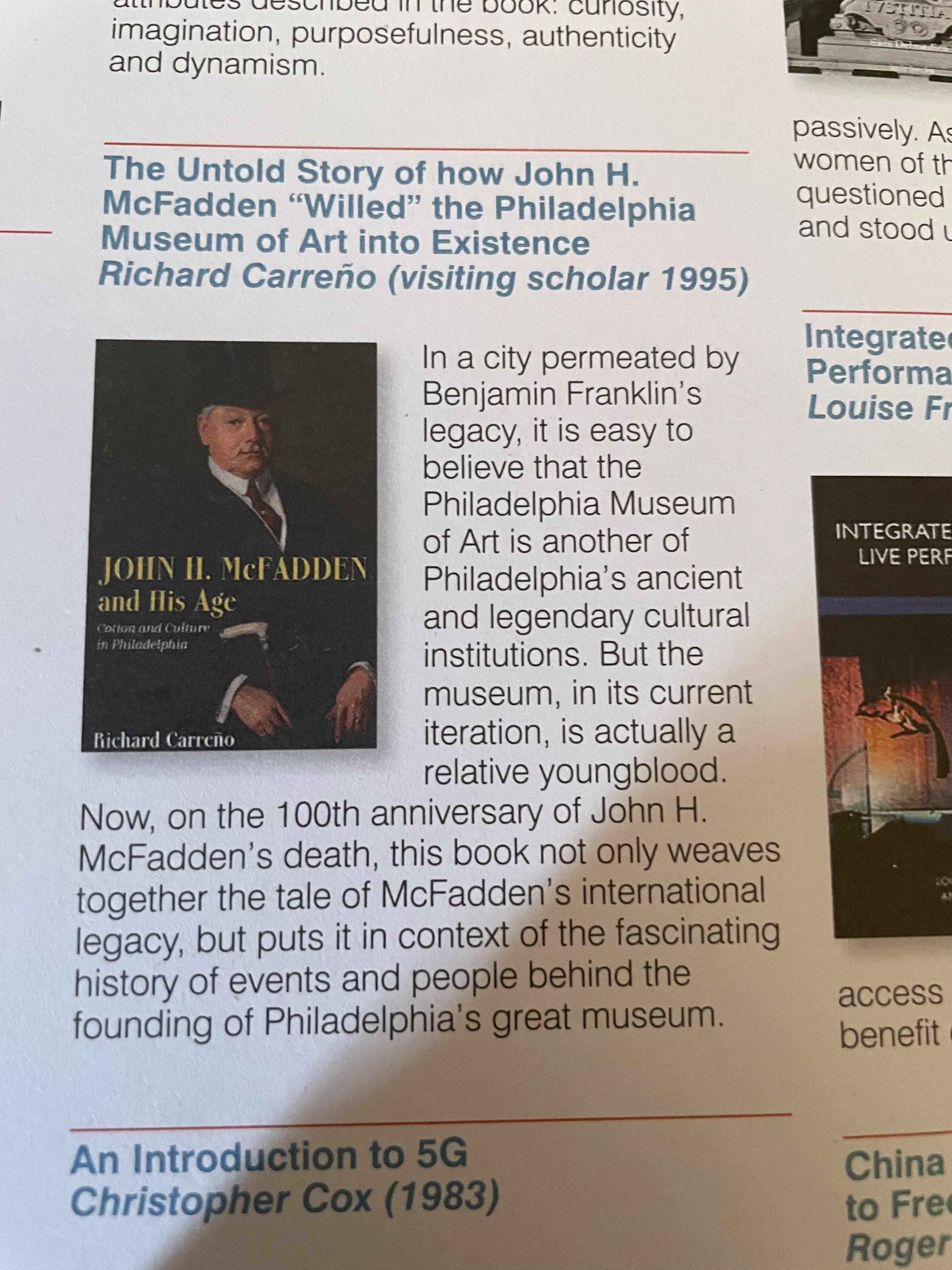


Richard Carreño 304pp.19 black and white illustrations. Camino Books, Philadelphia, 2021. Available from Amazon £18.69 hardback. ISBN: 978-1680980394.
I consider myself a reasonably well-read amateur Liverpool historian but confess that, until recently, I had never heard of John H McFadden. And, I suspect, neither had any of my fellow local history friends. This despite the fact that he and brother George headed up the biggest firm of cotton dealers not just in Liverpool during the late Victorian and early Edwardian era when the city was indisputably “King Cotton”, but on both sides of the Atlantic.
Like John Howard McFadden’s life itself, this is a book of two halves covering his early and later years in Philadelphia and his two decades or so in Liverpool when he was at the height of his cotton dealing powers. In spite of his business success and the great wealth that went with it, McFadden largely lived his life under the radar. So, it is thanks to Carreño that he has managed to tease out so much of the detail of his life. Aside from dealing in cotton futures, McFadden had three main passions, and the money to indulge them: medical research (of which Liverpool was a major beneficiary), polar exploration (and in particular Antarctic explorer Sir Ernest Shackleton) and assembling an outstanding private collection of 18th and 19th century British paintings by the great masters, including one by Liverpool horse painter George Stubbs.
 |
THE TOFF OF LIVERPOOL |

